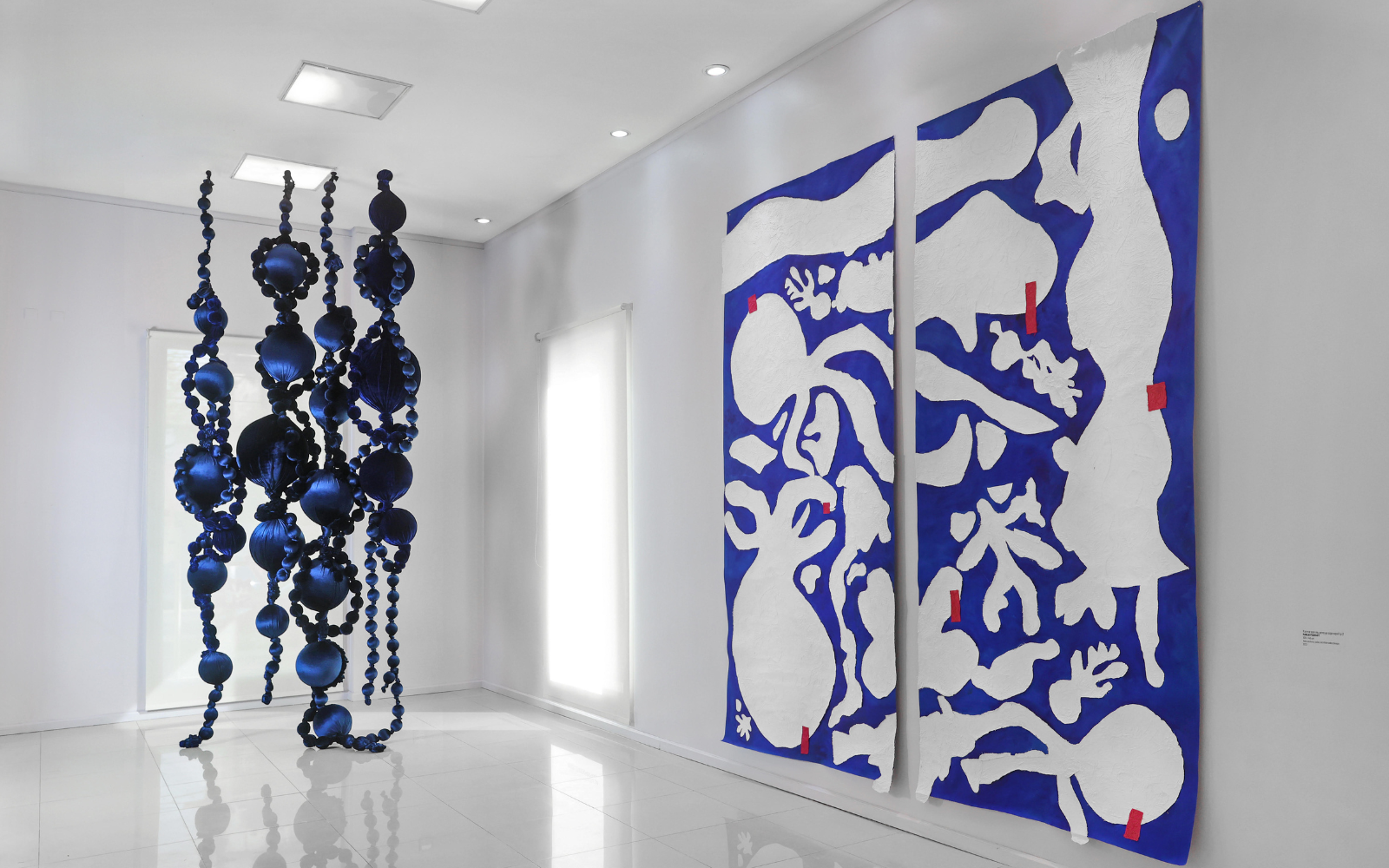
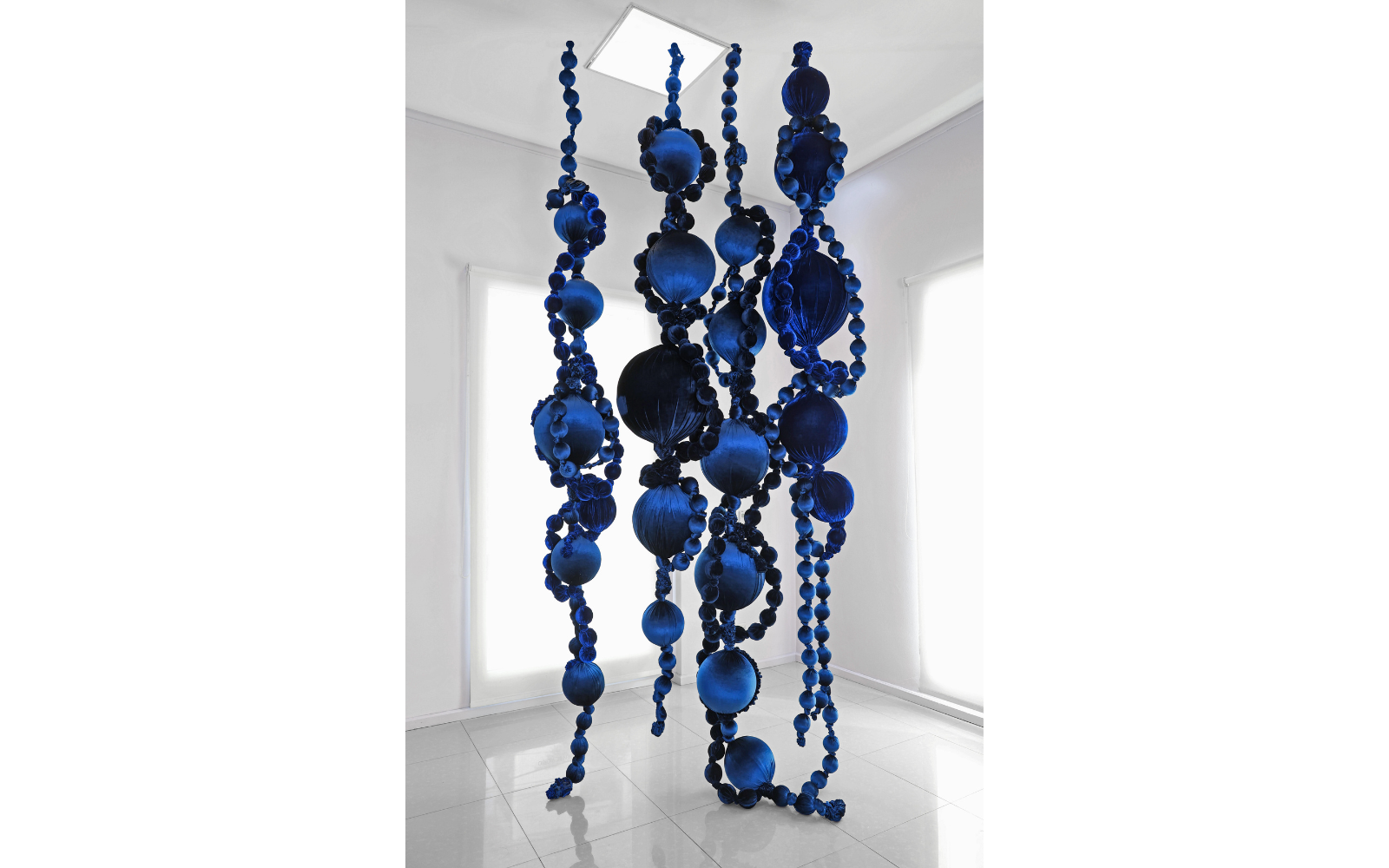
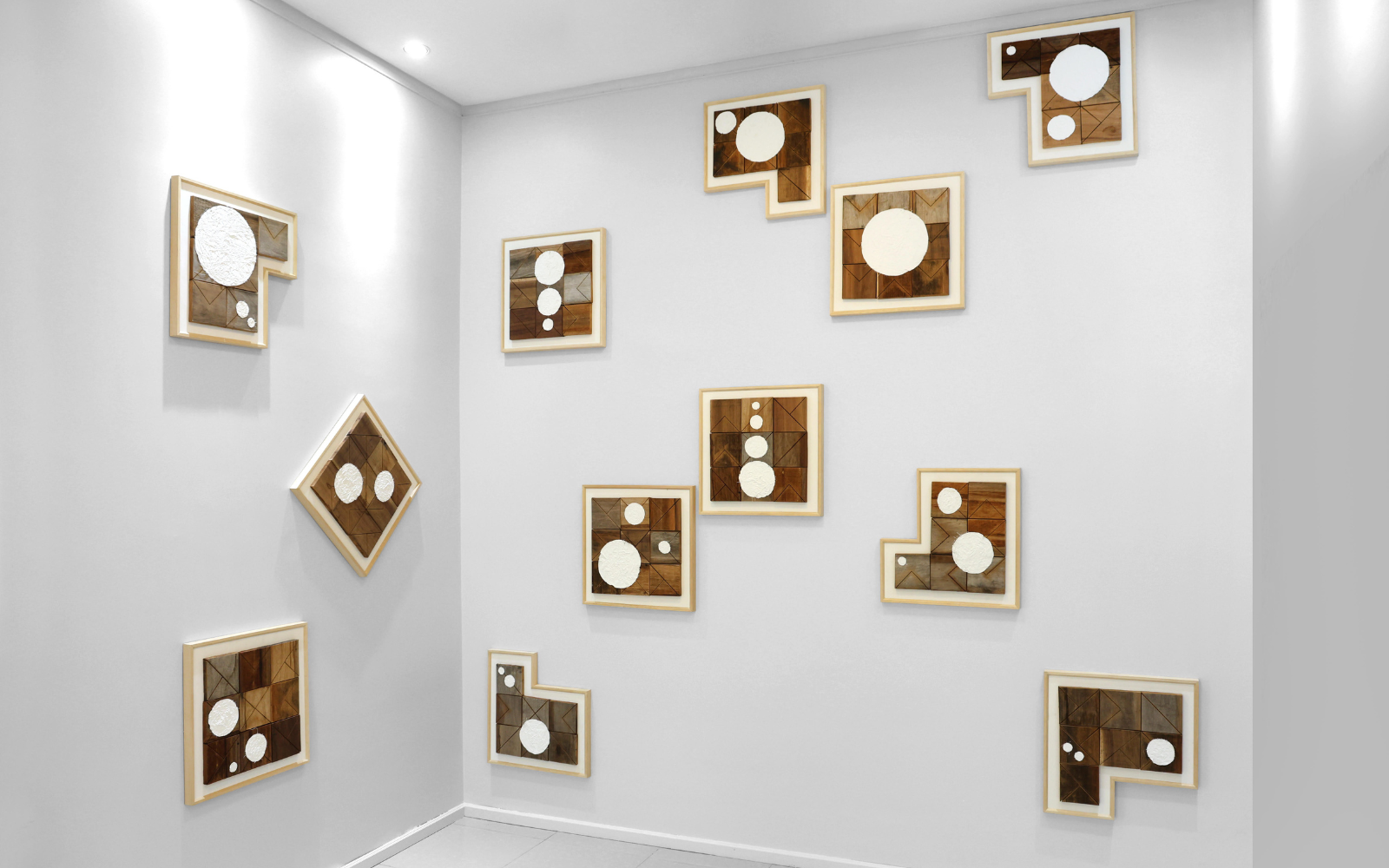
1 – In your works, there seems to be a deep exploration of human emotions. How do you manage to translate complex emotional experiences into shapes and colors?
I’m not sure I actually translate complex emotional experiences into shapes and colors, but I am certain that the process—the very act of painting or drawing—is enigmatic for the one who carries it out. Painting is a constant game in which gestures, the choice of colors, and formal decisions emerge more quickly from unconscious and instinctive beliefs than from anything rational or premeditated. It is different from the writing process, where language, structure, and syntax impose a certain formality and logic that keep me more aware of my choices.
When I immerse myself in a visual work, I explore unknown territories: I try out techniques, colors, and shapes in an exercise of trial and error, until I feel confident enough to choose and be more assertive. For me, painting or drawing is a release from the restrictions of words. Color, as a language in itself, becomes a tool to convey moods and vibrations. Each chromatic choice carries meaning, transmitting the intensity of the emotion or mood I feel or wish to communicate.
The same happens with line and brush movement: a firm stroke can express anger or passion; a soft stroke can convey calm, serenity, or melancholy. The act of creating, as well as the finished (or abandoned) work, is imbued with a meaning that transcends language. Perhaps that is why it is impossible for me to fully explain it.
2 – What is the foundation of your process and creative search?
From a pain I cannot rid myself of, from my incomprehension, from my inability to find logic. I think that’s why I have this obsession with putting words to everything: because my desire is to break the pain with words, and also with gestures, drawings, paintings, and with my body (when I perform). I want to break it or tame it.
There is something in my family history I cannot emotionally access, as if I were a tree unable to distinguish my roots beneath the ground, because I do not fully recognize them. And this now goes beyond childhood: it includes the choices I have made over the years, the roots that have intertwined with mine, what I have studied, the friends I have made and those I have not, the places I have lived, the people I have slept with, the man I chose to marry and have children with, the tragedies one cannot avoid.
Sometimes I think many of the choices I’ve made are the result of unresolved traumas, and also of a difficulty in asserting my desires and accepting my contradictions. All of this provokes in me such a furious and energetic revolt that it drives me into action — and it is the action, the making of my work, that creates a union with myself. But this has nothing to do with healing, and everything to do with the search for coherence with myself.
3 – Your works suggest an intimate connection between the inner and outer worlds. Where do you find the balance, if it exists, between expressing your personal experiences and allowing the viewer to create their own connection?
My personal experiences are the starting point. As the feminist slogan of the 1970s says: “The personal is political”, meaning that the goal is to bring personal experiences into dialogue with social and political structures. When I speak about myself, I speak about the other and about the world in which I am embedded. The private and the public, the individual and the collective, the inner world and the outer world are crucial themes in everything I have been doing since I published my first short story collection, The Lady of Solitude, in 2007. The work becomes a mirror where my experiences and those of the viewer converge, creating a space in which emotions and stories — both my own and others’ — intertwine in constant questioning.
4 – Is there a specific work that you feel especially reflects your voice and vision? If so, could you share more about how you relate to it on a personal level?
I cannot point to a single work, but my trajectory, from the beginning until now, has been a journey through a variety of media and disciplines. My “formal” artistic path began at the age of 20, when I started my Master’s in Fine Arts at The New School University in New York. At that time, I worked with experimental theater, and this approach gave me a solid foundation for exploring new forms of storytelling and communication.
Over time, I wrote works of fiction —short stories and novels— and literature gradually merged with elements of performance, video, drawing, and painting. This transdisciplinarity has been an integral part of my creative process. Although I don’t have a single work to highlight, the essence of what I do lies in telling stories —and a story can be a book, a video, a photograph, a drawing, or a painting. I feel that my voice has been shaped by these experiences and is reflected in the way I approach themes and experiment with different media.
5 – Art often reflects personal growth and transformation. How have you noticed your work evolving over the years, and what personal events or changes have influenced that evolution?
The evolution of my work has been a direct reflection of my personal growth and my acceptance of the changing, immeasurable nature of life. As the years have passed, I have experienced a profound transformation in the way I relate to my own artistic practice. I used to worry excessively about defining myself in specific terms —whether as a writer, visual artist, or in another role. That need to fit into predefined categories tormented me and made me feel that I belonged nowhere. I felt marginal —in the sense of being on the margins, without peers.
Over time, however, I have learned to allow myself to explore different forms of expression without worrying about labels. I have come to understand that my place is precisely at the crossroads of disciplines, in a space where there is no need for rigid definitions. Accepting change —which, after all, is the only certainty in life— and allowing myself to transform without the pressure of fitting into a “specific category.”
Today, more than ever, we live surrounded by definitions, statistics, numbers, and charts that seek to measure and quantify every aspect of our existence. These indicators claim to reflect everything from the most objective to the most abstract, assessing both what is considered successful and what is perceived as problematic. Statistics try to influence our understanding of what is going well or badly in different areas of life, whether in the economy, mental health, or individual happiness.
We see how everything around us is quantified: the stock market is monitored and evaluated based on numbers that rise and fall; world hunger is measured through statistics on income distribution or food availability; and depression and even happiness are translated into scales and scores. Even individual well-being and prosperity seem, in some way, to be tied to the same logic used to measure a nation’s GDP.
It is in this context that art —and here I am not speaking of my own work or personal transformation, but of the importance of art in all its forms— emerges as a fundamental refuge in people’s lives. Unlike metrics and numbers that attempt to capture our complex existence, art refuses to be quantified. Art is wonder, beauty, horror: it is intrinsically unquantifiable.
6 – When considering Hilma af Klint’s legacy, how do you think your current work aligns with her approach to abstract art? Are there specific aspects of af Klint’s philosophy that you find especially relevant today?
In 2018, I went to the Pinacoteca de São Paulo to see the Hilma af Klint exhibition. In the first room were The Ten Largest, and what more can I say? That I was struck by their beauty? That’s not enough. I was certainly surprised by my complete ignorance of her work until then. Perhaps this can be explained by the fact that af Klint herself did not recognize her own works as art. She broke with figuration, and only in recent years has she begun to be recognized as the artist who gave birth to the European abstract art movement —until I walked into the Pinacoteca, I believed the pioneers were two men: Kandinsky and Mondrian.
Since that visit, af Klint has become a reference and an inspiration. I left the exhibition with the catalogue because I wanted to have at home, within reach, a book with high-quality images of her works, and to learn more about the artist, her search, and her commitment to exploring the connection between the spiritual and the artistic.
7 – Abstraction often invites internal exploration. How does the act of creating affect you personally, and how is your self-exploration reflected in your work?
One must be willing to take a walk through hell, purgatory, and paradise.
8 – Your works can be interpreted in many ways. How do you feel when handing them over to the viewer? What kind of relationship do you hope will be established between your work and those who see it?
A work exposed to the public, to another’s gaze, is an invitation to continuity and dialogue. My wish is that the viewer, through my works, will have the space and freedom to explore their own labyrinths.
9 – What legacy do you wish to leave in the history of art and for future generations of artists?
My main focus is on creation and genuine expression in the present moment. My work is a reflection of my own journey, a continuous exploration of my emotions, thoughts, and experiences within a specific span of time — my lifetime. My wish is that, through my work, someone might feel encouraged to question, reflect, and find meaning in whatever they are seeking. And if I manage to resonate in the future, great — but that is not something that concerns me; I don’t think about it.