Year: 2013
Duration: 19 minutos
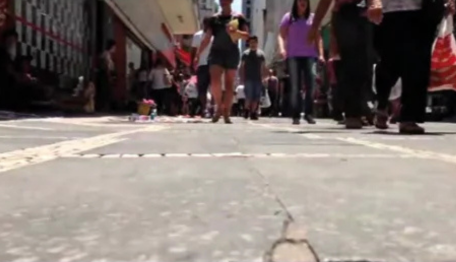
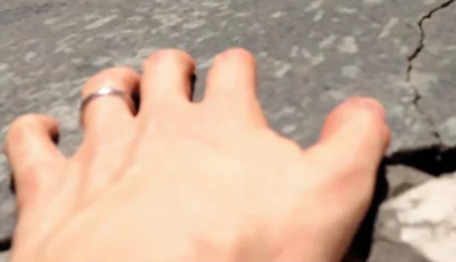
In São Paulo, on October 24th, 2013, at noon. Parisot, with her cell phone on, films herself as she crawls down the scorching downtown streets, which are boiling from the heat and the sun. While moving like a lizard, she registers everything that is going on at ground level. Her point of view, from below, on the edge of reality, symbolizes her situation as a desperate woman who has reached an incredible low in her emotional state. Unaware that her husband was deadly affected by a brain tumor, Parisot, a recent mother of twins, had lived the domestic nightmare of psychological abuse, of his hallucinations. Therefore, the performance could be understood as a need to feel what is real with all her body, even at the cost of hurting it or losing it. The artist got sores and burned her arms, legs and belly, like the penitents on the embers at St John’s Eve…
“You don’t have to sacrifice yourself. Jesus loves you. Jesus sacrificed Himself at the Calvary Cross,” we hear in the background.
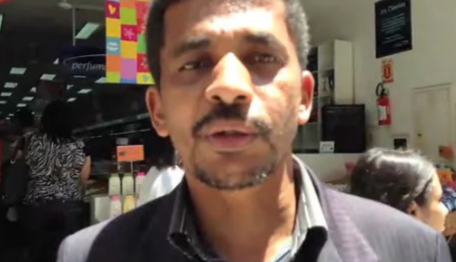
—Because Jesus already made the sacrifice at the Calvary Cross for you, okay? Believe in Jesus and you’ll be saved —urged an evangelic street preacher, one of the many in Brazil—. Let me anoint you —he scolded her.
The oil would produce the miracle of giving her back her speech; Parisot could not reply. She was silent, ecstatic, lost in an increasingly intense pain, “possessed” in the preacher’s eyes. “I don’t know why I did that, but I couldn’t stop doing it,” says the artist.
Another concerned pedestrian asked her:
—What are you taking a picture of? You don’t speak Portuguese…? Don’t you speak at all?
—It’s art, man —replied the young man who was with him.
—It’s some kind of artistic project? —The first man insisted.
—She’s not going to reply to you —claimed his companion.
—She’s just going to film us…?
The spectators of Parisot’s performance—the preacher and the “cultured” young men—are very valuable testimony for understanding the mechanisms of art reception. As theorized by Umberto Eco, every reader has their own “encyclopedia,” and they apply it to comprehend the aesthetic message’s ambiguity. Each of them used their own encyclopedia, but they all coincide when they grasp the symbolic meaning of the action. One of them, in a religious tone; the others, in an artistic one. For the body that performs it, the performance is a path towards self-knowledge. Nevertheless, the uninformed observer, at a spontaneous street action, is far from understanding it that way. They inevitably take it as an alienation from reality, from what is expected, which takes them by surprise and puts their consciousness in check. Is it or does it represent? That is the question that proves the distinctive ambiguity of the aesthetic message, and the reaction that every performance seeks from its viewers. Without knowing the performer’s motivations, poverty, marginality and the unattended madness on the streets of big cities like São Paulo provide the context for the effectiveness of the action. Poor, unprotected souls, hanging in a concentric limbo that swallows them up and spits them out without anyone noticing.
María José Herrera, July 2021